
In the Room Where It Happens: Reflections from the ECOSOC Youth Forum
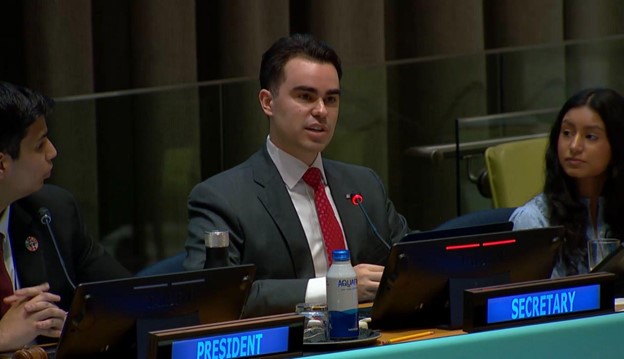
There is no substitute for being in the room.
I knew that going in. But knowing something abstractly and feeling it land are two different things. When I arrived in New York for the ECOSOC Youth Forum this spring, I was walking into what I had always imagined the Youth Observer role would look and feel like: the hallway conversations, the delegates from countries you do not often find yourself talking with back home, the sense that the work happening inside these walls actually connects to something larger than any one country or agenda.
It delivered on every count.
The ECOSOC Youth Forum is the United Nations’ primary annual platform for young people to engage directly with the Economic and Social Council, the body that drives the UN’s work on sustainable development, humanitarian affairs, and economic policy. It brings together young delegates from member states across every region, alongside UN agencies, civil society organizations, and youth-led networks. Walking the corridors, I ran into delegates from Albania, Burundi, Colombia, Ukraine, and dozens of countries in between, each carrying their own version of the same question: what does the next generation actually need, and who is listening?
America occupies a complicated place in that setting. We are simultaneously the institution’s most consequential member and funder and, in recent years, a source of real uncertainty about whether our membership means what it once did. I felt that complexity acutely. So I was both surprised and genuinely honored when the opportunity came to co-moderate the North America and Europe Regional Consultation.
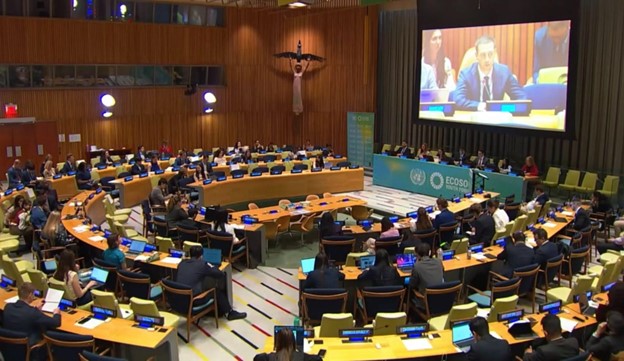
The session was held in the Trusteeship Council Chamber, designed by Danish architect Finn Juhl in 1952 as Denmark’s contribution to the UN building. The room speaks in warm wood tones and clean Scandinavian mid-century lines, intimate and monumental at the same time. Sitting at the front, looking out over the delegates, you feel the weight of what it has witnessed.
That weight is real. The Trusteeship Council was built to shepherd colonial territories toward independence. For decades, decisions made in that room changed the lives of millions. It went quiet in 1994, when Palau gained independence and the last trust territory was free. The mission was complete.
Now the room holds a different kind of reckoning. On this day, it held the voices of an incoming generation.
I co-moderated alongside Aryan Sanghrajka, with opening remarks from Andreea-Alexandra Scrioșteanu of the European Youth Forum and grounding context from Florence Bauer of UNFPA. Our panelists, Agne Vaitekenaite, Adam Ó Ceallaigh, and Arissa Roy, brought exactly what the room needed: clarity, urgency, and experience earned in the field, not just the conference hall. Twenty-one member states were represented. Dozens of young voices filled the space.
Three Americans spoke during that session. All three were UNA-USA members: myself as Youth Observer, Catherine Page as Co-Chair of the UNA-USA Youth Affinity Group, and Alan Cavagnaro as a UNA-USA Global Goals Ambassador. I did not fully appreciate what that meant until I was sitting at the front of that room. The country that helped build this institution, that helped write its charter, fund its infrastructure, and shape its first decades, was represented in that chamber by three young people who still believe it is worth showing up for, and UNA-USA opened up the door for all of us to be there. That felt significant. It still does.
The conversation that followed was not softened for public consumption. Young people from across the region named the gaps between what institutions promise and what they deliver. They named the ways economic instability, democratic backsliding, and climate disruption are not abstract policy challenges but daily realities reshaping their futures. And they did not flinch from the hard question underneath all of it: what would it actually take to fix this?
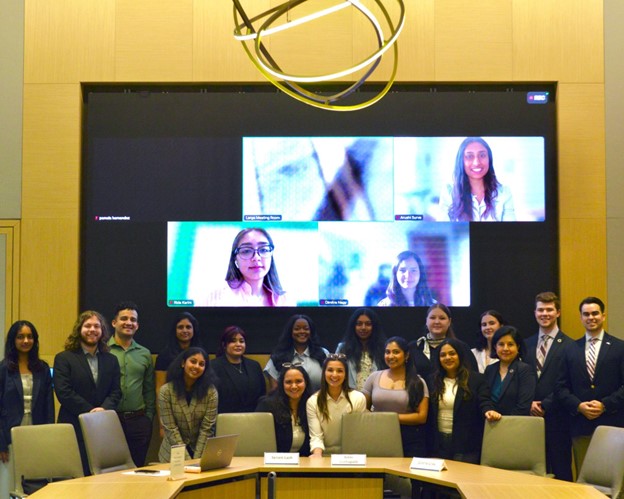
That question carried into the side events. At a joint session with the Girl Scouts of the USA, I presented early findings from the UNA-USA American Youth Priorities Report, the product of my national listening tour across the United States. The data told a story that is uncomfortable and clarifying in equal measure: young Americans are skeptical of institutions and, at the same time, unwilling to abandon them. That tension is not confusion. It is the defining posture of this generation.
Later, I moderated a side event organized by UNA-USA, UNA-Estonia’s Bogdan Janakov, and The Zero Hunger Project. That session ended with a question that stayed with me long after the room emptied: what is actually missing between young people and the institutions meant to serve them?
What I came away believing is this: the gap is not motivation. The young people I met at ECOSOC were not checked out, not naive, and not minimizing the scale of what is in front of them. They understood, often with sharp precision, what it would take to build a more just and stable world. They were not retreating from any of it.
The Trusteeship Council Chamber was built to hold the work of decolonization, to give the world a place to dismantle one order and build something more just. That work, in that form, is finished. But the room is still standing. And during the week of the ECOSOC Youth Forum, it was full of young people who believe that complex problems require shared forums, honest conversations, and the patience to see them through.
There is no substitute for being in the room. And what UNA-USA does, more than any other organization I know, is open the door and make sure Americans walk through it. Not as observers. Not as skeptics watching from the margins. As participants, fully present, ready to do the work. Catherine, Alan, and I were in that chamber because UNA-USA put us there. Because the organization believed that American voices belong at that table, and acted on that belief.
An increasingly interconnected world does not run on autopilot. It runs on institutions worth defending and people willing to defend them. From where I sat at the front of that chamber, looking out at delegates from two dozen countries, I did not see a generation in retreat. I saw young people from around the globe showing up, boldly, deliberately, and with full knowledge of what the moment requires.
That is what UNA-USA makes possible. And it is worth everything.