
Reflections from UNPFII25: Indigenous Leadership, Climate Justice, and the Future We Choose
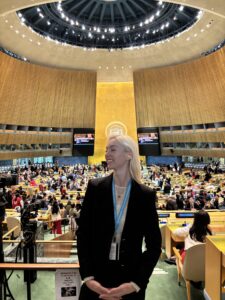 It was an incredible honor to serve as a UNA-USA delegate to the Twenty-Fifth Session of the United Nations Permanent Forum on Indigenous Issues (UNPFII25). The experience was deeply moving, at times heartbreaking, and profoundly inspiring. Throughout the Forum, I had the privilege of listening to Indigenous leaders, youth advocates, elders, policymakers, researchers, and organizers from every corner of the globe speak about the realities their communities are facing as well as the solutions they are already leading.
As someone whose background is rooted in sustainability and who has had the privilege of working alongside Indigenous communities across Northeast India, I came to the Forum already understanding that Indigenous Peoples are often among the first and most severely impacted by climate change, biodiversity loss, and extractive development. Yet they are also among the world’s greatest protectors of biodiversity and holders of knowledge systems humanity urgently needs to learn from.
UNPFII25 reinforced something that became impossible to ignore throughout the week: any meaningful conversation about sustainability, climate resilience, or regenerative futures must center Indigenous leadership and Indigenous rights. Again and again, the Forum demonstrated that Indigenous wisdom is not simply about preserving the past, but about helping guide the world toward a more balanced, interconnected, and sustainable future.
Indigenous Communities and the Climate Crisis
One of the most striking realities discussed throughout the Forum was the disproportionate burden Indigenous communities carry in the face of environmental destruction. While Indigenous Peoples comprise only around 6.2 percent of the global population, they safeguard much of the world’s remaining biodiversity (Food and Agriculture Organization of the United Nations [FAO], n.d.).
Despite this critical role, Indigenous communities continue to face displacement, contamination of sacred lands, violence, exclusion from decision-making, and the weakening of legal protections. It was heartbreaking to hear testimony from Indigenous leaders across the United States describing how environmental protections have been stripped away in the rush to expand mining, extraction, data centers, and large-scale energy projects. Speakers discussed the accelerating approval of these projects occurring without meaningful consultation or informed consent from impacted Indigenous communities.
One particularly powerful side event organized by Cultural Survival featured an interview with Elder Petuuche Gilbert of Acoma Pueblo on the devastating impacts of uranium mining and nuclear energy development on Indigenous health and land. Listening to speakers share stories of contaminated water, cancer, intergenerational trauma, and the desecration of sacred sites was a brutal reminder that environmental destruction is never abstract. It is deeply human.
Throughout the Forum, one message was clear: climate justice cannot exist without Indigenous justice.
Indigenous Relationship to Land
What moved me most deeply throughout the Forum was hearing Indigenous leaders speak about their spiritual relationship with the land and the understanding that humans are not separate from nature, but intrinsically connected to it.
Again and again, speakers described land, water, plants, and animals not simply as part of an environment, but as relatives, teachers, and living beings deserving of care, reciprocity, and protection. How there is no separation between us and the nature that surrounds us.
In many ways, I believe this worldview represents one of the greatest lessons (of the many) Indigenous communities offer humanity at this moment in history. Modern systems often prioritize extraction, consumption, and economic growth detached from ecological balance. Yet most Indigenous knowledge systems are rooted in the understanding that human wellbeing cannot be separated from the wellbeing of the Earth itself.
I find it baffling how disconnected many societies have become from the natural world. And yet, I believe most people still recognize that connection deep within themselves. We feel it when we stand quietly in the forests, beside oceans, or under open skies long enough to truly listen.
The tragedy is not that humanity lacks connection to the Earth, but that many systems have conditioned us to ignore it. At UNPFII25, Indigenous leaders reminded the world that another way of relating to land, community, and future generations is possible.
Language, Healing, and Cultural Survival
One of the most inspiring side events I attended was “Language Revitalization as Healing: Effective Engagement of Elders in Language Teaching Efforts,” organized by the Standing Rock Sioux Tribe.
The session highlighted how language preservation is not simply about communication, but about identity, memory, ceremony, healing, and cultural continuity. Elders spoke about the emotional and spiritual impacts of reclaiming Indigenous languages after generations of forced assimilation and cultural suppression.
When a language disappears, entire worldviews, ecological knowledge systems, histories, and cultural relationships risk disappearing alongside it. Protecting Indigenous languages is therefore not only a cultural issue, but also a matter of protecting humanity’s collective wisdom. Learning about the programs being led by the Standing Rock Sioux Tribe filled me with so much hope and reverence for the work being done.
Indigenous Youth, Innovation, and the Future
Another powerful theme throughout the Forum was the rise of Indigenous youth leadership.
A particularly compelling side event, “The Gen-Z Movement in Nepal: Intergenerational Pathways for Indigenous Land Rights and State Conflict,” highlighted how youth are reimagining activism, identity, and political participation in rapidly changing digital spaces. It was especially powerful in light of recent events in Nepal, where Gen Z organizers used platforms like Discord to create spaces for dialogue, coordination, and collective decision-making during a moment of national upheaval, demonstrating how digital tools are being transformed into spaces of civic participation and leadership formation.
Similarly, the session “MaasaiGPT – Youth-Led AI for Indigenous Health & Culture” demonstrated how Indigenous youth are engaging with emerging technologies while simultaneously preserving cultural identity, language, and traditional knowledge.
My perspective, shared by many in these spaces, was that technology in these contexts must be approached with care, intention, and accountability. There were extensive discussions around data sovereignty, informed consent, and the importance of ensuring that Indigenous perspectives are meaningfully included in the design and development of emerging technologies. These conversations challenged the idea that Indigenous knowledge and technological innovation exist in opposition to one another. Instead, many Indigenous youth leaders are demonstrating that technology can be a powerful tool in service of cultural preservation, healthcare access, education, and environmental stewardship.
This was one of the most hopeful aspects of the Forum for me: witnessing Indigenous communities not only protecting ancestral knowledge, but actively shaping future systems.
Rethinking Health and Wellbeing
The Forum also expanded conversations around health in ways many Western institutions often fail to recognize.
The side event “Indigenous Health in Unexpected Places: Plant Medicine, Economic Wellbeing, and Biodiversity Across International Agencies and Bodies” explored the interconnectedness of ecological health, cultural health, spiritual wellbeing, and economic systems.
One important takeaway from this session was that health cannot be reduced solely to clinical outcomes. For many Indigenous communities, health includes connection to land, access to traditional foods and medicines, language, ceremony, cultural continuity, and collective wellbeing.
This broader understanding of health offers important lessons for societies worldwide, particularly as many countries grapple with rising mental health challenges, loneliness, environmental anxiety, and chronic disease.
Lessons from a U.S.– UN Lens
From a U.S.– UN perspective, UNPFII25 highlighted both progress and ongoing contradictions.
The United States often positions itself as a global leader on democracy and human rights, yet Indigenous communities within the country continue to face systemic inequities tied to land rights, environmental contamination, healthcare access, cultural erasure, and political representation.
At the same time, forums like UNPFII demonstrate the importance of international spaces where Indigenous voices can directly shape global conversations and build solidarity across borders.
One of the clearest lessons I took away from the Forum is that international agreements and declarations alone are not enough. Real progress depends on implementation at local, state, national, and international levels. Global conversations must translate into local action.
Actionable Steps for Local Communities
One of the most important questions I left the Forum asking myself was: what does this mean for communities back home?
Many people assume Indigenous rights are only relevant in distant places or international policy spaces, but Indigenous justice issues exist within every local community in the United States.
There are many meaningful ways UNA members and local communities can support Indigenous health and rights:
- Learn the Indigenous history of the land where you live and acknowledge the tribes and nations connected to that place.
- Support Indigenous-led organizations, artists, educators, and businesses.
- Advocate for meaningful consultation and free, prior, and informed consent processes around environmental and development projects.
- Attend Indigenous cultural events, educational forums, and community gatherings.
- Support language preservation and cultural revitalization efforts.
- Elevate Indigenous voices within sustainability and climate conversations.
- Advocate for policies that protect sacred lands, water rights, biodiversity, and tribal sovereignty.
- Build relationships rooted in listening, humility, and long-term solidarity.
Most importantly, we must recognize Indigenous Peoples as rights-holders and leaders whose knowledge, governance systems, and practices are essential to advancing a more sustainable future.
Leaving with Hope
Despite the painful realities discussed throughout the Forum, I ultimately left UNPFII25 feeling hopeful.
Hopeful because I witnessed extraordinary resilience. Hopeful because Indigenous youth are rising as leaders. Hopeful because elders continue carrying wisdom across generations.
Hopeful because communities around the world are protecting lands, languages, cultures, and futures not only for themselves, but for all of humanity.
Indigenous leadership offers a vision of reciprocity, stewardship, interconnectedness, and long-term thinking that our world urgently needs. The lessons shared at UNPFII25 were not only meant for governments or institutions. They were invitations for all of us to reconsider how we relate to one another, to the Earth, and to future generations.
I left the Forum inspired and with a deeper understanding that, despite the scale of today’s challenges, Indigenous communities are not only leading solutions in the present, but hold profound hope for our collective future.