2025-2026 Global Goals Ambassadors Blog Posts
One of the key responsibilities of our Global Goals Ambassadors is to use storytelling and strategic communications to advance the Sustainable Development Goals (SDGs). The blog posts below showcase their voices, experiences, and expertise as they highlight the importance of their chosen SDGs and inspire action in their communities.
Each post reflects an Ambassador’s unique perspective, offering insights on local challenges, innovative solutions, and opportunities for meaningful engagement. Through these blogs, our Ambassadors raise awareness, spark dialogue, and encourage others to take action in support of a more just, equitable, and sustainable world.
We invite you to explore the posts below, learn from our newest cohort of Ambassadors, and join them in advancing the Global Goals.
GLOBAL GOALS AMBASSADORS BLOG POSTS:

Armando Parrish
Recently, I had the privilege of attending the “Global Youth Dialogue” hosted by Junior Chamber International (JCI) for the 2025 Global Goals week! During this webinar, I had the opportunity to listen to leaders directing JCI’s operations across the globe, specifically within the Asian region.
Notably, I thoroughly loved breaking out into small groups to break down the topics we learned from the primary speakers! Furthermore, I would like to posit an improvement for the topics discussed: I strongly believe the best ideas come from human interaction; therefore I posit that the breakout rooms should take up most of the time for the zoom. Finally, reflecting on my role as a Global Goals Ambassador for SDG 1: No Poverty, I strongly felt encouraged by the leaders at JCI to go out and galvanize the youth within the United States to willingly take up the “path less travelled” towards an equitable, just, and youth-driven world.
Anjani Sharma – Global Youth Dialogue 2025: Youth Voices Shaping the Future of Development
On September 24, I attended the Global Youth Dialogue 2025, hosted by Junior Chamber International (JCI). The event brought together young leaders from across the world to reimagine how education, employment, and equality intersect with global development. What stood out most was the insistence that youth are not just beneficiaries of policy but architects of solutions.
For me, as an advocate for SDG 1 (No Poverty), the discussions highlighted how poverty cannot be solved in isolation. Education (SDG 4) and employment (SDG 8) are both catalysts for breaking cycles of inequity, while political participation ensures sustainable solutions. The dialogue emphasized innovation, leveraging technology to close gaps in access, resources, and opportunity.
Still, I left with one question: how can governments, particularly in the United States, ensure that youth-driven ideas are not just heard but implemented? At the local and state level, this means investing in equitable education and fair wages. Nationally, it means prioritizing policies that address structural poverty, not just symptoms.
The event highlighted that ending poverty requires collaboration across sectors. By listening to youth and embedding their voices into decision-making, we move closer to a future where no one is left behind.
Grace Magny Fokam – Reflections from Climate Week NYC’s FoodTank at UNGA80
“As climate extremes continue to threaten harvests, can innovation outpace hunger?”
This was the question explored at Climate Week NYC’s FoodTank session “Food Security Solutions in a World of Climate Extremes”, held alongside the 80th United Nations General Assembly. As a Global Goals Ambassador for SDG #2 (Zero Hunger), I had the pleasure of representing UNA-USA and hearing from thought leaders making bold discoveries on how AI, policy, grassroots organizing, and nutrition science can meet the urgency of climate-induced droughts and floods.
One of the standout moments for me came during the “Artificial Intelligence for Good” panel. Alexander Diaz, Head of AI for Social Good at Google.org, reminded us that AI is most powerful when built with communities, not just for them. In highlighting how AI is now enhancing weather forecasting and detecting pests through computer vision, he reinforced what I’ve seen in my own work as a climate AI researcher: technology can be used to make agriculture more sustainable, especially when made equitable and accessible to farming communities.
I left the event also reflecting on what this means for domestic policy. With the recent federal funding cuts to small farms and global food assistance programs, paired with the rise of large language models, it’s imperative that we push to restore and expand investments in agricultural research, climate-resilient farming, and AI for food security. Policymakers and private sector leaders must act now to ensure agricultural workers receive the support they need to maintain our food systems.

Sangeeta Sunny – A Development Crisis: Lessons from UNGA80’s HLM4 on NCDs and Mental Health
At the recent Fourth High-Level Meeting (HLM4) on Noncommunicable Diseases (NCDs) and Mental Health, world leaders emphasized that these challenges are not only health issues but development crises. The meeting opened with a full-day plenary where presidents, prime ministers, and UN leaders underscored the staggering $30 trillion projected economic cost of NCDs between 2011 and 2030 and the urgent need for stronger political will.
The discussions then moved into two multi-stakeholder panels. The first examined social, economic, and environmental determinants of NCDs and mental health. A panel co-chair captured the tone by stating, “NCDs and mental health challenges are no longer silent epidemics. They are persistent. They are deeply intertwined with social, economic, and environmental factors.” The second panel focused on health system reform and sustainable financing, highlighting opportunities for equitable access to medicines and services.
While the political declaration set a new vision through 2030, it left out critical elements such as stronger commitments on air pollution and health taxes. This raises key questions about accountability and financing. For the United States, where NCDs remain leading causes of death and mental health care is under strain, these global commitments intersect directly with local debates on health equity, insurance coverage, and affordable access to treatments like GLP-1 therapies.
HLM4 also showed that action on NCDs links far beyond SDG 3. From climate change to gender equality, the solutions discussed cut across multiple global goals. The challenge now is ensuring that this momentum translates into real, measurable action worldwide.
María Barragán Ortiz – Building Resilience & Strengthening Access to Education for Girls in Crisis Settings
On September 23rd I had the opportunity to attend Building Resilience & Strengthening Access to Education for Girls in Crisis Settings, an inspiring side event at the UN General Assembly organized by ChildFund Alliance, Islamic Relief USA, Malala Fund, Plan International, and the Women’s Refugee Commission.
With only five years left to achieve the 2030 Agenda, the urgency of advancing girls’ education—particularly in conflict and crisis contexts—was at the center of the conversation. Opening remarks underscored that millions of adolescent girls remain out of school due to violence, displacement, economic barriers, and gender-based discrimination. The session set the tone with a quote from Michelle Obama: “Educating girls is one of the most powerful things we can do, not just for girls and their families, but for their communities and their countries.”
What stood out most were the powerful reminders that education is not only a human right but also a pathway to safer, healthier, and more equitable societies—something I strongly believe in. Investing in girls’ education leads to lower maternal and child mortality rates, higher lifetime earnings, and stronger, more peaceful communities. The call was clear: protecting education in all contexts and ensuring continuity, even amid emergencies, must be a global priority.
Panelists emphasized innovative approaches such as flexible learning options, safe spaces, psychosocial support, and stronger policy frameworks, as critical to building resilience. Above all, the voices of girls themselves must guide these efforts.
Leaving the event, I was reminded that achieving SDG 4 (Quality Education) and SDG 5 (Gender Equality) is not just an aspirational goal, it is an urgent responsibility. Ensuring every girl’s right to education, especially in times of crisis, is truly essential for building a just and sustainable future.
Caden Choi – Global Goals Week Highlight: Global Youth Dialogue
As this year’s #GlobalGoalsWeek wraps up. I reflect on one of my favorite events: the Global Youth Dialogue hosted by Junior Chamber International (JCI)—a global network of young leaders driving change.
Attendance? 662 live participants + 3,600 Facebook Live views. Keynote speaker Godfrey Alumai (UN Youth Office) said: “1 in 5 young people are not in education, training, or employment.” He also reminded us, “We cannot restore the SDGs without putting young people at the center.”
The event closed with interactive workshops where participants designed sector-specific action plans across Community Impact, Business, International Cooperation, and Individual Development.
Hundreds responded to a survey question: “Which SDG are you most motivated to work toward?” The front-runner easily, SDG #4 – Quality Education.

Cindy Chen
I joined an SDG 5 Virtual Gathering during Global Goals Week 2025, which was an online event that brought together advocates, researchers, and youth leaders from around the world to discuss progress toward gender equality across the globe. The focus on the group was the newly published five-year accountability report of SDG 5 outlining both advancements in education, leadership, and representation—but also recessions in reproductive rights, prevention of gender-based violence, and equitable workplaces. What struck me most was the shared understanding that these setbacks transcend borders. Gender inequality anywhere weakens progress everywhere.
The discussion emphasized that achieving SDG 5 means doing more than making a symbolic commitment. It requires institutional commitment of financial resources with clear budgets and evaluations to work toward policy change. Discussion also included ways to weave gender into budgets in national policy, and how enforcing existing laws to protect equality rights can assist in normative practices, especially in the context of countries with deepening political polarization.
And later, we witnessed the Global Goals Summit 2025, broadcasting live from both New York and Nairobi, demonstrating how women’s equality is foundational to sustainable development across every sector; panelists connected women’s empowerment to economic benefits, peace-building, and democratic stability.
SDG 5 is at the core of SDG 8 (Decent Work) and SDG 16 (Peace, Justice, and Strong Institutions). Finding equality for women and girls strengthens every institution and system it touches—showing that gender justice is not only global policy, but it is also the basis for sustainable progress.

Eugenia Boateng – From Talk to Action: Why Africa is Unstoppable Now
Attending Unstoppable Africa with the UN Global Compact left me both inspired and challenged. As a young African in the diaspora, I often hear conversations about what Africa could be. But this event was different, it stopped at nothing short of solutions. It was not about what should be done, but how to do it, and what strategies are already being implemented to improve Africa today.
One of the most powerful moments was the fireside chat with Senegal’s President Bassirou Diomaye Faye, Africa’s youngest elected leader. His journey from tax inspector to president reminded me that leadership does not wait for permission—it requires courage. His ambitious $1.7 billion digital sovereignty plan is proof that young leaders are not only inheriting challenges, but also engineering bold solutions for their people.
Equally compelling was Prime Minister Mia Mottley’s intergenerational dialogue with youth across Africa, Asia, and the Caribbean. The exchange showcased that young people are not leaders in waiting, we are leading now, forging new alliances across continents and generations.
Being a Global Goals Ambassador for SDG 6, attending Unstoppable Africa reminded me that water and sanitation are not isolated issues, they are the foundation for progress across every goal. During my research in Tanzania, I saw how lack of clean water and safe sanitation directly impacted women’s health and dignity, especially during menstruation. Hearing leaders at the event discuss solutions for jobs, innovation, and women’s empowerment reinforced that the SDGs matter as a whole, because none of these ambitions are sustainable if people are still denied access to something as basic as clean water.
Daniel Thomas – Water at the Heart of Climate Action
During Global Goals Week I attended the Climate World Foundation’s fireside chat, Water Narratives: Sustainable Water Management. The description of the Amazon as “the heart of the biosphere” is striking. Both scientists and Indigenous leaders developing the statement’s outcomes related that not only does the rainforest literally create rivers on land, but also creates atmospheric rivers (rainfall) in the sky, that regulate North America’s and our world’s rainfall. This really reinforced a very powerful truth: protecting water systems means protecting life itself.
One of the more unforgettable parts that was shared from Indigenous communities was the commitment to “do no harm.” The protection of the watershed system is a sacred responsibility. Their bioregional modeling systems demonstrated how treating rivers as interconnected lifelines, rather than isolated resources, can unite communities across borders. Business leaders also emphasized that when farmers manage water and soil sustainably at their local level, climate resilience and biodiversity naturally follow.
For me, as a Global Goals Ambassador for SDG 6: Clean Water and Sanitation, this event made me realize water is not a side issue, it is the core of our climate response. U.S. policymaking can replicate these practices and invest in watershed restoration and community-driven water management.
The conversation also showed how water connects multiple SDGs, from food security (SDG 2) to climate action (SDG 13). Addressing water is addressing all. Water connects all of them. Our responsibility as youth and emerging leaders is to remind decision makers that the choice is really simple: when you choose water, you choose life.
Jeffery Liu
On September 28th, I had the privilege of attending the Climate Week NYC workshop on Exploitation and Debt—Implications for Climate and Human Services in Africa. It was my first time attending one of these events, and I was thoroughly inspired by what went on.
Relating to the global goal I represent, decent work and economic growth, this webinar openly exposed how Africa had been exploited for centuries. To do this, the webinar provided at first a case study on Ghana, showing implications of exploitation, colonialism, and racism on the country’s capability to provide healthcare and education to its people. I found it amazing to explore a real life example of the often overlooked effects that still play a role in today’s world.
Additionally, the perspectives introduced show how it is critical to advocate for more policy and practices to fix and amend the damage done to the countries of the global south.
Moreover, the topics discussed can be interpreted beyond just my SDG. The webinar also mentioned the ongoing climate crisis, and relates climate/sustainability to a more broader impact that eclipses the economic growth aspect. I had an amazing time listening to these important subjects, and look forward to more events as a Global Goals Ambassador!
Emmanuel Ohiri – Redefining Growth: Lessons from Panama for a Sustainable Future
During Global Goals Week, I attended the Panama Roundtable: Advancing Connectivity and Innovation for the Future of the Americas at the 2025 Concordia Annual Summit, hosted in partnership with the Government of Panama and the Inter-American Development Bank (IDB). The conversation between Panamanian President José Raúl Mulino and IDB President Ilan Goldfajn offered a striking contrast to the skepticism that now clouds global development discourse.
Both leaders portrayed Panama as “open for business,” but not in the old extractive sense of the phrase. Their emphasis was on inclusive, innovation-driven growth — economic expansion that strengthens social stability and environmental resilience alike. To this end, Panama’s ministries, particularly its Ministry of Environment, are working to ensure that future investments support both people and the planet.
This vision matters. As Adam Tooze argues in “The End of Development,” the Sustainable Development Goals faltered not because they lacked ambition, but because they were divorced from political and economic realities. Panama’s example shows what grounded, pragmatic development can look like, acknowledging shifting global dynamics yet insisting on shared prosperity.
At a moment when the United States retreats from the SDGs, countries across the Americas are stepping forward. Sustainable development is not a “globalist” luxury; it is sound economics and good governance. The question for U.S. policymakers is simple: will we lead this next era of inclusive growth, or watch it unfold without us?
Rida Karim
Pipelines on Earth stretch far enough to reach the moon and back twice. That fact, shared at the FP Energy Forum by Dr. Mikala Krishnan of McKinsey Global Institute, captured the scale of the challenge. She reminded us that the energy transition is not a simple switch in fuels, but the rebuilding of an entire system that has taken more than a century to construct. For SDG 9, which focuses on resilient infrastructure and innovation, the numbers are sobering. As Dr. Krishnan explained, we are only ten percent of the way toward the construction required for a net-zero future. The remaining ninety percent is steel, minerals, and transmission lines that must be deployed at speed. She noted that “half of the challenge is execution,” ranging from scaling grids and installing chargers to strengthening supply chains, while the other half is innovation, from new approaches in steel and cement to hydrogen and carbon capture. What stood out was her warning that only 5 to 10 percent of the needed investment is flowing into affordable, ready-to-scale solutions.
This raised a question: how can U.S. policy direct financing toward these basic but critical upgrades, rather than leaving them underfunded? Permitting reform also emerged as a clear barrier, with grid connections taking years to approve. Addressing this at the national level would accelerate progress. The Forum underscored that SDG 9 anchors every other effort. My takeaway is that its success will show in the durability of what is built and sustained over time.
Angela Zhong Closing the Loop: Why Rare Earth Recycling Matters for American Cities
At “Closing the Loop: Rare Earth Recycling to Power the Energy Transition” during NYC Climate Week, one statistic stopped me cold: less than 1% of rare earth materials are currently recycled. These minerals power everything from electric vehicles to wind turbines to data centers, yet we’re treating them as disposable in a single-use supply chain.
Ahmad Ghahreman of Cyclic Materials, alongside investors from Microsoft and Energy Impact Partners, made a compelling case that rare earth recycling isn’t just environmental stewardship. It’s essential infrastructure for sustainable cities. When cities commit to electric transit systems or renewable energy grids, they’re betting on a stable supply of these critical materials. Right now, that bet relies almost entirely on mining and geopolitically fragile supply chains.
The conversation revealed how SDG 11 intersects with goals around innovation (SDG 9), responsible consumption (SDG 12), and climate action (SDG 13). Our cities can’t become truly sustainable if the materials powering that transformation aren’t circular. The panelists emphasized that recycling rare earths from discarded electronics and industrial equipment could create domestic supply chains, manufacturing jobs, and reduced environmental impact.
The rejection of “globalist” frameworks ignores a basic truth: American cities competing for talent, investment, and livability need these materials. Whether sourced from abroad or recycled at home, rare earths are global by nature. The question isn’t whether to engage with this reality, but whether we’ll lead in creating resilient, circular solutions or remain dependent on others.
Shanaiya Miller – Global Youth Dialogue: Advancing SDG 10 Through Youth Voices
On September 24th, I joined the Global Youth Dialogue hosted by Junior Chamber International (JCI), a gathering of over 1,000 young leaders from more than 270 places worldwide. For two hours, my screen filled with faces and voices speaking in English, Spanish, French, and Japanese, proof that a truly inclusive world is possible.
As someone passionate about SDG 10: Reduced Inequalities, I was moved by Godfrey Alumai of the UN Youth Office, who urged us to “make space for youth at the table” and to fund our ideas. In breakout sessions, we discussed access to mental health care, digital devices, and quality education. I listened to peers from Japan, Madagascar, and Mexico who echoed my own hopes: we all want communities where opportunity is not dictated by birthplace, income, or identity.
What struck me most was the sense of solidarity: hundreds of messages, emojis, and notes of encouragement flying across the chat. Even though we came from different countries and time zones, we found common ground in our belief that equality is worth fighting for.
This event left me inspired and hopeful. If world leaders truly listen to youth voices and invest in our solutions, I believe we can create a future where inequality steadily shrinks and everyone can thrive.
Maddy Chang
I attended InnerView’s release of the 2024–25 SDG Youth Impact & Insights Summary during Global Goals Week. The report highlighted how students across the country put in over 2 million service hours, creating nearly $69 million in community impact. You see the numbers first, but the real message is about the student voice. Young people are building trust, leading peers, and demanding to be heard. If you care about reducing inequalities, this matters. Students from Title I schools, rural towns, and suburban districts all contributed. Still, the report showed gaps that aren’t often acknowledged. Some groups don’t have the same access to service because of technology, transportation, or outreach. If you want equity, you have to remove those barriers.
This connects directly to SDG #10: Reduced Inequalities and to policy in the U.S. Schools and local governments should treat service as civic learning. Give students credit, funding, and recognition so everyone can participate. At the national level, lawmakers should take student input seriously when writing policy. The lessons also stretch beyond inequality. They touch education, sustainable communities, and climate action. When you empower young people, you don’t just solve one problem — instead, you unlock progress across many Global Goals.
Alan Cavagnaro
During my first UN Global Goals Week 2025, I attended The Business Imperative for Sustainability, an in-person panel in New York City featuring leaders from finance, fashion, and consumer products. Speakers included Gregg Meyer, Gauri Angrish, Emily Chasan, Gayatri Sarkar, and Erika Karp (seen above), who spoke about why sustainability is not just good for ethics, but good for the private sector and business growth as well. Panelists stressed that environmental and sustainable strategies are central to growth.
The relevance for me to SDG 11 – Sustainable Cities and Communities, was clear. Private entities are involved in the conversation because top-down mandates from the public sector do not always work. Buy-in from small and large businesses toward greener initiatives will allow communities of the future to increase utilization of electric buses, light rail, hybrid technology, and even bikes made from recycled materials. The private sector helps shape cities by investing in crucial goals and driving innovations that improve how people live and how communities grow.
How do we make sure these strategies are accessible to the most vulnerable communities? Accountability and transparency will be key to guaranteeing real impact. Global Goals Week reminded me that ensuring global frameworks and policies are grounded within the community they hope to aid. If we all exhibit that mindset, the physical outcomes of the SDGs can become far more tangible than when they were first established.
Margaret Chipassi – Building Cities that Care
During the SDGs Roundtable Discussion 2025, I was struck by how much sustainable cities depend on empathy, dialogue, and youth leadership. Speakers like Serra Kazan, a young U.S. advocate, shared how communities thrive when faith groups and civic leaders unite to improve public health.
That message deeply resonated with me because I see similar potential right here in Plano, Texas. Our city is growing fast, with neighborhoods rich in culture, diversity, and innovation. Yet, like many U.S. suburbs, we face challenges of isolation, limited walkability, and environmental strain. Imagine
channeling Plano’ s community spirit into youth-led programs that mirror those global stories — students partnering with local faith centers to plant shade trees, create “neighbor hubs” for newcomers, or turn unused parking lots into gathering gardens.The Global Youth Voices Digital Interfaith Storytelling Campaign reminded me that cities become sustainable when we turn compassion into collaboration. Whether through storytelling, volunteering, or advocacy, young people can transform city life one idea at a time. Let’s lead the change. Let’s live the SDGs — one city, one community, one act of care at a time.
Our city is growing fast, with neighborhoods rich in culture, diversity, and innovation. Yet, like many U.S. suburbs, we face challenges — from limited walkability to heat islands and the need for stronger community connection. These local actions echo SDG 11 by making our spaces more inclusive, green, and connected.
Imagine channeling Plano’s community energy into youth-led initiatives that reflect those global stories: Faith and civic groups partnering to plant trees in areas that lack shade or green space. Students mapping safer walking and biking routes to reduce car dependence and improve air quality. Neighborhood “Welcome Corners” where newcomers and long-time residents share cultural experiences through mini community markets, clean-up days, or weekend art events.
Living sustainably isn’t just about recycling or driving less — it’s about how we live together.
Siyeon Joo
On September 24th, I joined young leaders and changemakers from around the world at the Global Youth Dialogue 2025, hosted by Junior Chamber International (JCI). This virtual event, held in support of Global Goals Week, sparked powerful conversations about how youth are driving progress on education, employment, equality, civic participation, and climate action.
What stood out most was the passion and creativity of the participants surrounding democratic participation and youth involvement. The fireside chat and multilingual workshops underscored how global youth development thrives on diverse perspectives, practical advocacy, and cross-sector partnerships. I was especially encouraged by the emphasis on accountability — not just demanding change, but actively building and sustaining momentum for a more sustainable future.
One question I posed to the organizers was how these global dialogues might translate into local policy change, particularly in regions where climate action faces political resistance. Moving forward, I hope to see even greater focus on equipping participants with actionable tools to influence policy in their communities, especially given the intersectional nature of climate justice.
The conversations made it clear: SDG #13 (climate action) is deeply connected to education, employment, and equity. Climate action and youth-led innovation are not mutually exclusive. Supporting youth leadership across these domains is essential for building a fairer, more resilient world. Through events like this, young people aren’t just discussing the SDGs — they’re redefining what it means to lead global solutions from the ground up
Tarun Batchu
The first time I was truly able to capture the severity of Climate Change was during a religious pilgrimage my mom and I took in India in first grade, with the goal of visiting as many different temples that concentrated on countless deities of Hindu culture. Having been my first conscious visit back to India, I had never really encountered noticeable detriments to a sustainable environment. At this time, I viewed hazards like thick smog, contaminated rivers, and plastic pollution as issues only senior politicians could tackle.
I’m now grateful to understand that youth are increasingly in a position to make positive impacts within their communities. When I joined the Global Youth Dialogue 2025, presented by Junior Chamber International, I was struck by how often youth leadership and sustainability came up in the same sentence. Although the event covered a range of issues beyond climate, such as education, employment, and equality, the thread I kept pulling on was how each connects back to climate action. To me, the call for stronger civic participation was closely related to how young people can lead local initiatives, including those that concern environmental advocacy.
I also attended an AI ethics webinar presented by UNGA, where the discussion was dominated by the sustainability of data and this technology. I think it’s important to note that tools like AI can help predict extreme weather. The takeaway is clear: progress on SDG #13 depends on connecting climate solutions to broader movements for equity and innovation.

Robin Happel – A Whale of a Time at Global Goals Week
What do a costume parade, a play, and a panel have in common? Global Goals Week! For Global Goals Week I attended multiple events related to ocean conservation and sustainability as a Global Goals Ambassador for Life Below Water, beginning with an NYU Law panel on the He Whakaputanga Moana treaty. In line with Māori beliefs of whales as ancestors, this historic treaty was signed by Pacific leaders to recognize whales as legal persons. This treaty will provide additional protection to whales, aligning closely with Sustainable Development Goal 14.
Legal personhood of animals is a cutting-edge legal topic, but has ancient roots. As a pro bono attorney with Earth Law Center, I also attended a play called The Animals’ Lawsuit Against Humanity, based on a thousand-year-old Sufi tale of a sea monster and other animals suing humans for their mistreatment in the court of the djinn (spirits). This play was followed by a panel discussion of spirituality and animal protection across Judaism, Islam, and Christianity, moderated by climate activist (and daughter of Ilhan Omar) Isra Hirsi. Finally, this past weekend I dressed as a melting glacier in Earth Celebrations’ procession celebrating the re-opening of East River Park in lower Manhattan, with costumes honoring the Sustainable Development Goals, marine life, and the park itself. Organizers also recognized local community contributions to making the park more climate-resilient. The parade was followed by speeches by Congressman Dan Goldman and other politicians, and served as a powerful reminder that supporting the SDGs begins locally.

Emily Geest – Small Actions, Big Change: Protecting Life on Land
Conservation cannot succeed in isolation, it depends on partnerships that link science, education, and community. This message was central to the 2025 UNA-USA Global Goals Week, where panels spotlighted the urgent need to protect ecosystems under growing pressures from land use change, climate change, and accelerating species loss.
Equally important as global policy frameworks are ensuring that biodiversity solutions are both actionable and accessible. The Association of Zoos and Aquariums and its member institutions, such as the Oklahoma City Zoo and Botanical Garden, are strong examples of this approach. Every year, these institutions engage millions of people and translate big goals into everyday actions: planting pollinator gardens to help monarch butterflies, recycling old phones and small electronic devices to reduce mining pressures in gorilla ranges, and supporting endangered species recovery through headstart programs.
These kinds of community-level actions are powerful because they scale upward. In the United States, pollinator gardens improve habitat while strengthening agricultural systems, and cellphone recycling programs help reduce demand for unsustainable resource extraction. At broader levels, state and national policies can safeguard landscapes and prevent extinctions. Together, local stewardship and large-scale frameworks create the layered approach biodiversity protection requires.
The UN Sustainable Development Goals are deeply interconnected, and biodiversity sits at their core. SDG #15: Life on Land reminds us that protecting terrestrial ecosystems is not only about conserving species, but also about sustaining the landscapes that support human well-being. Protecting Life on Land is a shared responsibility, and when small actions multiply across communities, it has the potential to drive big change for both people and wildlife.

Suzanna Schofield – Lessons from the frontlines: How do we protect the environmental movement?
For the past month, federal efforts have been underway to rescind the Roadless Rule, which protects approximately 44.7 million acres of National Forest System lands,1 for logging and mining.
I have lived in forests my entire life, worked in national parks, and spent years advocating for conservation. I feel disempowered when facing federal policies that are cutting back environmental regulations and opening the land to complete devastation. So, I spent the week attending events that would guide my perspectives on how to address key environmental concerns in such a pivotal political moment. My question – how can we protect our public lands and how can we protect us?
As a GGA to SDG 15, Life on Land, I was inspired by an event co-hosted by WWF, NWF, and Environmental Advocates NY.
Speakers included Alfred Lahai Gbabai Brownell, Sr., a Liberian environmental activist and lawyer who fought a palm-oil producing company by building a resistance of community members. Documenting the intimidation and harassment, deforestation, and the desecration of sacred sites by the company, Brownell led a campaign that succeeded in protecting 500,000 acres of land. The true power of the people. Now, he leads an organization that provides legal services to climate activists facing criminalization.
He said – “It doesn’t matter what we do if we don’t protect the movement” , remarking on the importance of community support when facing giants.
So, in moments of uncertainty, that is what I will turn to – we are more powerful than we believe.
Hope lies with us.
Michael Lihanda
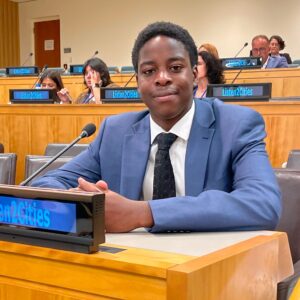
On September 24, I attended an exclusive Youth Dialogue with former United Nations Secretary-General Ban Ki-moon, hosted by the Ban Ki-moon Foundation in New York City. Surrounded by young leaders from across the world, I also met the UNA-USA’s 14th Observer to the UN, who spoke about how U.S. institutions must embody the same democratic integrity we advocate for abroad. The discussion centered on Sustainable Development Goal 16—peace, justice, and strong institutions—a principle that underpins every other SDG.
When I spoke personally with Mr. Ban, he told me that “true justice begins when young people refuse to accept corruption as normal.” That statement reframed how I view civic responsibility. SDG 16 is not just a global ambition—it is a domestic imperative. From voting rights to equitable access to the legal system, the United States cannot champion peace and justice internationally while neglecting transparency and inclusion at home.
The dialogue revealed how SDG 16 intersects with others: strong institutions enable climate accountability (SDG 13), gender equality (SDG 5), and quality education (SDG 4). As youth advocates, we must call on U.S. policymakers to align national reforms—like civic education and justice-system modernization—with the SDG framework.
Mr. Ban’s words still echo: “Peace is built by those who believe institutions can be better.” That conviction defines my generation’s mandate—to safeguard the legitimacy of justice itself.
UNGA80 SDG Media Zone — September 2025
At this year’s UN General Assembly SDG Media Zone, the session “Fashion’s Role in the Global Circular Economy” explored how the fashion industry can move from a linear “produce, use, dispose” model toward one rooted in regeneration and collaboration.
Speakers emphasized that circularity must begin at the design stage — embedding integrity, transparency, and innovation throughout every layer of production and consumption. It’s not just about what happens at the end of a garment’s life, but how it’s created from the start.
From material innovation to resale models, the discussion highlighted how fashion can balance creativity with accountability. Upcycling, rewearing, and policy reform were all cited as key levers in shaping a more sustainable and equitable future for fashion.
I found this session a strong reminder that progress happens when industries align practice with purpose. Like every sector, the fashion and creative industries have the power to lead by example — turning circularity from concept into culture.
Sustainability is no longer a side conversation. It’s the blueprint for fashion’s next chapter — and the choices we make today will define the industry we leave behind tomorrow, and for future generations.
Alexa Pascual
As UNA-USA’s SDG 16 Global Goals Ambassador, I had the privilege to represent civil society and youth in conversations with governments and business leaders on tech, health, and finance throughout UN General Assembly 80. Speaking at a roundtable with Salesforce and Meta and ITU Secretary-General Doreen Bogdan -Martin, I emphasized the significance of preventing misuse of artificial intelligence — a goal that will be paramount when it comes to human security, as well as U.S. competitiveness. AI use by traffickers in deepfakes and manipulative content targeted towards women and youth can have a devastating impact on not only vulnerable communities, but public trust in the tech industry writ large, making the ethical guardrails and public-private cooperation we are starting to see now a strategic imperative.
At the UN High-Level Hearings on Mental Health and NCDs, I was struck by how countries are rethinking mental health as a challenge of governance and security, not only public health. From SDG 3 to SDG 16, building up mental health care systems can increase resilience, bolster inclusive institutions, and support peaceful societies directly.
From Barclays, I know that AI will also be a disruptive force in the field of sustainable finance, driving innovation in climate resilience and risk management, but it can also compound risks to inequality and financial stability if left unchecked by ethical guardrails. The cycles of rise and decline of economies are not just abstract trends, they have direct implications for national and global security. Economic instability can erode institutions, drive disinformation, and heighten susceptibility to exploitation, making it imperative to focus on sustainable, inclusive growth.
Observing the SDG discussions at the UN, I was struck by how the Goals are not some high-flown ideal, but a pragmatic tool. The Goals show us time-tested ways to improve U.S. and global security, promote economic resilience, and demonstrate American leadership to help build a safer, more prosperous world.
Also, one of my favorite parts of the week was meeting Gillian Anderson — a reminder that the arts also help to advance the Global Goals.
Sean Schrader
It was a pleasure to be back in New York City, this time for the United Nations 80th General Assembly. This was my first time being on the ground for the UN General Assembly, but not my first in New York City. In 2023, I had the opportunity to be a delegate at both the ECOSOC Forum, and a multistakeholder forum on public engagement. Although those were exciting, I found this experience to be much more fast paced because of the significant number of delegations, envoys, and organizations on the ground.
Although potential reforms to the UN operating structure have always been discussed, it seemed like there was a much larger focus on the topic this year. Personally, as a Global Goals Ambassador for SDG 17, I believe some much can happen at the local level, and that local change, and opportunities for impact should be championed as a meaningful solution to drive results.
Through the events I attended, including the High-Level Plenary Meeting of the General Assembly to Commemorate the Thirtieth Anniversary of the World Programme of Action for Youth, and side events with The NAT and The Goals House, I shared this sentiment of local action in my meetings.
There is always work that can be achieved in delivering on the sustainable development goals, and creating a better future for all, but work that’s already been achieved must be recognized, both in celebration, and as a roadmap for future steps.
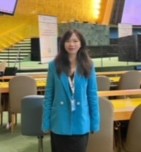
Li Zhang – Partnerships for the Goals: the way forward after UN80
The final SDG, #17, is a partnership. Cooperation, multilateralism, solidarity, better together, these are the words heard the most during the past week – a week of the UN’s 80th General Assembly and to advocate for the Global Goals.
During the past week, I learned about the gains and the pains, the good news and the bad news, the solutions and the gaps during the past decades. The world is not united enough. It is not bi-polar either. The world is multi-polar. This is the point made by Mr. António Costa, President of the European Council of the European Union, in his remark at the 80th UN General Debate.
There needs to be a shift in our way of dealing with the new world. Ms. Rebeca Grynspan, Secretary-General of the UNCTAD termed it as the “new multilateralism” and pointed to the role of regionalism, in a side event during the high-level week. “We should stop thinking about Africans as vulnerable. We should think about them in their capacities, and that is a continent full of opportunities for the future,” Ms. Grynspan said.
This reminds me of a blog article by Ms. Cristina Duarte, UN Special Adviser on Africa, calling for a reinforced role of States and their capacities as the primary actors in global development.
Foreign Minister of Rwanda, Mr. Olivier J.P. Nduhungirehe, also urged for a transition from international aid to trade, for African countries to be more self-reliant. These views shed light on global cooperation in today’s world, where we need to unleash potential in individuals, nations, and regions, to empower them to build a better world for themselves and by themselves.